Those Left Behind in the Age of Independence
THE DUTCH GIRL SEARCHING FOR HER GRANDMOTHER FROM CIMAHI
By Denny JA
(When the Dutch colonized Indonesia, 1819–1942, countless native women became servants in foreign homes—unwritten wives called “Nyai.”
They bore children who belonged not to them, but to the empire’s silence.) (1)
⸻
The building stood like a ghost wearing new skin.
Sixty years ago, in 1940,
it was a humble food stall woven from bamboo ribs—
a shelter for soup, smoke, and a secret love.
Now, the year 2000,
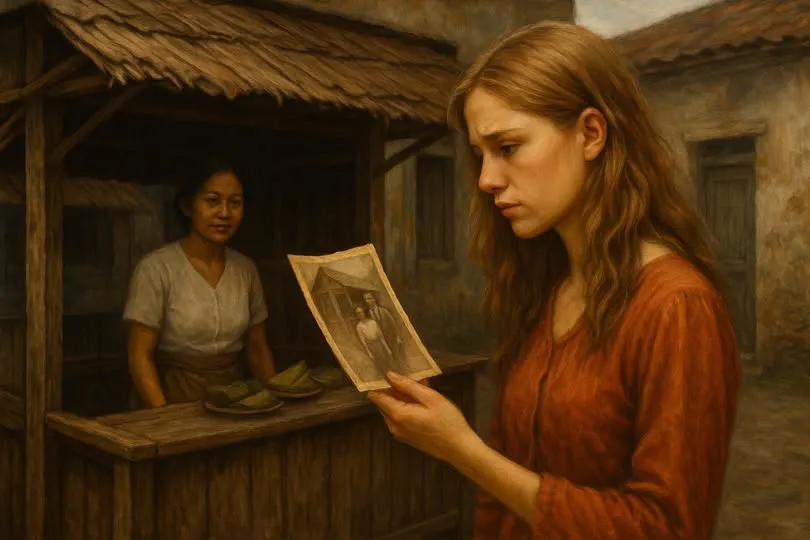
a Dutch girl named Fagal stood before it,
holding a photograph the color of forgotten rain.
The image—yellowed, brittle—whispered to her:
The past is not dead; it waits inside the dust.
The wind carried murmurs of another age—
a Sundanese woman, Elis,
selling rice wrapped in banana leaves,
while a foreign man sipped coffee
as if tasting a different sky.
Soon, love crossed the line of empire.
Walls turned into curtains,
and from that forbidden tenderness was born Marteen—
the man who would one day become Fagal’s father.
But where was Elis now?
If still alive, she would be eighty,
her memories folded like old sarongs in a wooden chest.
Fagal came to find her—
the grandmother who lived only in rumor and wind.
⸻
When Marteen was two,
war came wearing the mask of the Rising Sun.
Her grandfather fled with the child,
promising Elis,
“I will return when the storm is gone.”
Elis clung to her son
as if her arms could stop the century from turning.
He wept, too—
a man torn between continents and vows.
Back in Holland,
a wife waited under the calm cruelty of respectability.
Elis was left behind—
a heart stitched into the soil of Cimahi.
“Bring my son home,” she begged,
“even if only in your dreams.”
And then—two shadows vanished from her life.
⸻
Years folded like letters never sent.
In Amsterdam, half a century later,
an old woman named Oma Martha lay dying,
calling for Fagal.
Her breath was a thread unraveling.
Her voice, a cracked window between guilt and grace.
“I have sinned against your father,” she whispered.
“Until his death, he believed I was his mother.
I let him live inside that beautiful lie.”
The confession detonated softly
inside Fagal’s ribs—
like thunder muffled by snowfall.
“When your grandfather brought him from Indonesia,
he was only two.
When he died in an accident,
your father was three—
an orphan of history.”
“I raised him with love,”
Martha said,
“and selfish joy.
Even as cancer hollowed him,
I could not tell him.
His peace was too fragile to break.”
She began to sob—
a sinner who had carried tenderness as her sin.
Fagal wept with her,
their tears mingling like two rivers
finally meeting the same sea.
“Find your true grandmother, child,”
Martha gasped.
“Let truth have a grave,
and love, a name.
This photo is all I have.”
⸻
A small stall.
A woman’s blurred face.
A single line of ink: Cimahi, 1940.
For a week,
Fagal walked through the veins of the city—
asking, listening, piecing together
the shards of a woman erased by empire.
She learned a word that ached like a scar: Nyai.
A name for the nameless.
A woman who belonged to everyone and no one.
A body rented by power,
a mother without custody of her own blood.
The law did not protect her.
The Church did not bless her.
History did not write her.
And yet—within that silence,
love had dared to grow.
⸻
Fagal found letters, rumors, memories in the air.
Her grandfather had loved Elis truly—
not as a master loves his servant,
but as a soul recognizes its twin
in an unexpected mirror.
He fled not from her,
but from war.
He planned to return.
But fate—a patient thief—
stole his life before peace arrived.
Now, before that weathered building,
Fagal understood why her grandfather
had photographed the stall.
This was not merely a place.
It was a portal—
where hunger became affection,
and two worlds touched hands
beneath the indifferent sky of empire.
⸻
Yet sorrow clung like dew.
No one knew what became of Elis.
Some said she was taken by soldiers,
sent to Borneo as a laborer—
another body claimed by the machinery of war.
Fagal gazed again at the building,
its shadow spilling across the street like memory.
Then—something trembled in the air.
Two butterflies, pale as forgiveness,
circled above the roof.
They danced—slow, certain, radiant.
And Fagal knew.
They were her grandparents—
Elis and the Dutch man—
returning not to haunt,
but to thank her
for finding what history had tried to forget.
Jakarta, May 16, 2024
Notes
(1) Inspired by many true stories of Indonesian women known as “Nyai.”
Among them: Nyai Itih of Cimahi, whose life once captivated a Dutch journalist.
BERITA TERKINI