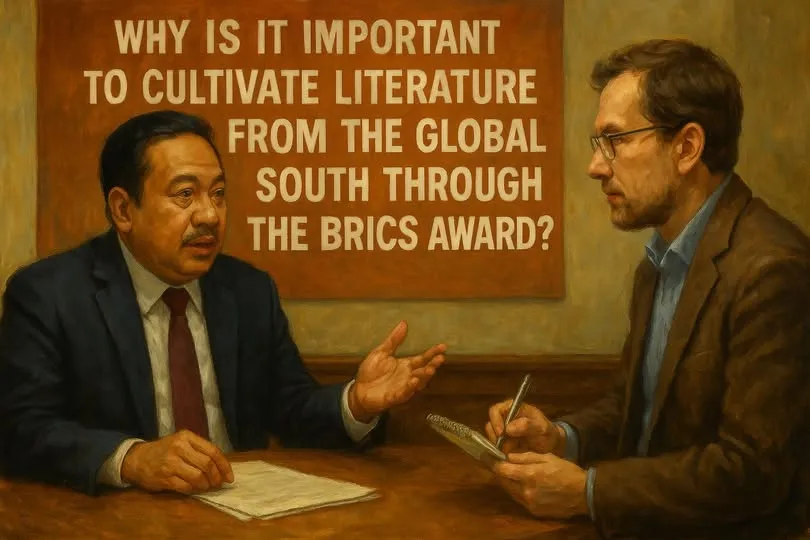
WHY IS IT IMPORTANT TO CULTIVATE LITERATURE FROM THE GLOBAL SOUTH THROUGH THE BRICS AWARD?
1. You have said that the Nobel Prize cannot serve as a compass for world literature, and that the genuine pulse of humanity beats not only in European cafés, but also in the rice fields of Java, the African savannahs, the Brazilian favelas, and the ancient villages along the Yangtze.
Can you give examples of such literature? Which authors would you recommend, who do you personally admire, and whose works would you prioritize for translation into Russian?
Answer:
Indeed, the vitality of world literature emerges not from a single cultural axis, but from the polyphonic voices of the Global South.
From Indonesia, the works of Pramoedya Ananta Toer, Leila S. Chudori, and Ayu Utami reveal the intertwined struggles of colonial memory, political turbulence, and personal liberation.
In Africa, Chinua Achebe, Chimamanda Ngozi Adichie, and Ngũgĩ wa Thiong’o offer narratives that confront identity, history, and the burden of post-colonial transformation.
From Latin America, Jorge Amado and Carolina Maria de Jesus capture both the dignity and despair of Brazil’s forgotten classes.
And in China, Mo Yan and Yu Hua illuminate the surrealism and brutality of rapid social change.
If I were to prioritize translations into Russian, I would begin with Pramoedya’s Buru Quartet and Ngũgĩ wa Thiong’o’s A Grain of Wheat—works that speak universally about resilience, injustice, and the human hunger for dignity.
I also write Indonesia’s history in fictionalized form through my seven essay-poetry books. But one of the seven focuses specifically on the great dramas of world history.
-000-
2. Among Nobel laureates, there is actually quite a lot of literature about life in the Global South. For example, Abdulrazak Gurnah, Salman Rushdie, and the current laureate László Krasznahorkai, whose writing is not really classic European mainstream.
Why do you think these works do not satisfy the demand that “Asia is not just an exotic backdrop, but the emerging melody in global consciousness?”
Answer:
Their works are powerful, but they remain framed within a European institutional ecosystem. The lens through which they are evaluated, promoted, and canonized still gravitates toward Western sensibilities.
Asia today is not merely seeking representation; it is demanding narrative sovereignty, the right to define its own metaphors, moral dilemmas, and philosophical landscapes.
Until global literary institutions truly decentralize their cultural compass, stories from the Global South will often be curated rather than organically celebrated.
-000-
3. By the way, why Asia in particular?
Answer:
Asia is home to more than half of humanity and is rapidly becoming the epicenter of economic, technological, and cultural dynamism.
Its civilizations are among the oldest, yet its modern transformation is among the fastest. Asia represents continuity and disruption at once—a combination that produces profound literary tensions.
In many ways, the future of global imagination is being written here.
-000-
4. What are you working on now? What topics do you think are important to discuss today?
Answer:
I am currently exploring three interwoven themes: energy geopolitics in the age of AI, the evolving identity of Southeast Asia in global diplomacy, and the moral crisis of digital-era humanity.
In literature, I continue developing the essay-poetry form to capture emotional truths within factual narratives. The topics I find crucial today are energy justice, technological ethics, and the urgent need for cultural bridges in an increasingly polarized world.
-000-
5. How did you become a writer—when did you start, and was it difficult to get published?
Answer:
I began writing as a teenager, driven by the instinct to understand the world through stories.
My early works circulated in small communities before finding larger publishers. The difficulty was not publication itself, but finding a form that could express both intellect and emotion.
Essay-poetry emerged from that search—a hybrid capable of carrying both clarity and lyricism.
-000-
6. Are there any programs in Indonesia to support writers—such as writers’ unions or residency programs for young people?
Answer:
Yes, though they are still evolving. Indonesia has writers’ associations such as SATUPENA, emerging creative residencies, and government-sponsored cultural grants.
However, support remains fragmented. What Indonesia truly needs is a sustained ecosystem—translators, residencies, international partnerships, and digital platforms—to nurture its literary talent and bring it to the world stage.
myself built the essay-poetry community, which has now expanded across Southeast Asia. The fourth Southeast Asian Essay-Poetry Festival has already been held.
I also established the Denny JA Foundation, which presents annual awards to writers
-000-
7. What is the most difficult aspect of your profession for you? And what attracts you to it? Where do you find your stories?
Answer:
The greatest difficulty is maintaining honesty—intellectual honesty, emotional honesty, and cultural honesty. Yet that is also what attracts me: literature forces one to face truth without the armor of politics.
I find stories everywhere: in the quiet dilemmas of ordinary people, in the wounds of history, in the contradictions of power, and in the shifting moral landscape of our modern world.
-000-
8. Do you know Russian literature? Whom do you read or admire?
Answer:
Yes. Russian literature has shaped global thought in profound ways. I admire Fyodor Dostoevsky for his psychological depth, Leo Tolstoy for his moral imagination, and Anton Chekhov for his quiet mastery of human vulnerability.
I have watched Doctor Zhivago repeatedly and also read the novel by Boris Pasternak.
I am deeply moved by the tragic love story of Dr. Yuri Zhivago and Lara, set against the sweeping social upheaval of the Russian Revolution
-000-
9. For which work were you nominated for the BRICS Award? Are you hoping to win, or are official awards less important to you?
Answer:
My nomination was for my body of work in essay-poetry, particularly my contributions to bridging literature, democracy, and social reflection. Awards are meaningful as forms of recognition, but they are not the destination.
What matters more is whether one’s work continues to travel across borders and illuminate shared human concerns.
“Yes, of course I hope to win, because I want to continue advocating for BRICS literature as an alternative voice to the Western-dominated world canon.”
-000-
10. You have said that literature is the quietest yet deepest diplomacy. Could you give concrete examples of this—either today or historically?
Answer:
Certainly. Uncle Tom’s Cabin reshaped American moral consciousness and influenced political currents worldwide.
Tagore’s works built bridges between India and Europe long before diplomatic treaties did. In modern times, the global readership of Murakami, Adichie, and Yu Hua has fostered empathy between cultures that rarely meet politically.
Literature travels farther than embassies; it speaks to the conscience, not the negotiation table. That is why it is the quietest yet deepest form of diplomacy.
“The essay-poetry form that I created is now regarded as a part of literary diplomacy in Southeast Asia.”
(Jakarta, 13 Nov 2025)
BERITA TERKINI