
— Welcoming Denny JA’s Selection as One of Ten Global Nominees for the 2025 BRICS Literature Award —
By Cerah Budaya International (CBI)
History is often portrayed through historical fiction—from Tolstoy, who paints war through love, to Pramoedya, who writes resistance through the fates of ordinary people.
But Denny JA chose another path. He does not write history in prose, but in essay poetry—a genre he himself pioneered, a bridge between social fact and the trembling pulse of the human heart.
As a thinker and a devoted watcher of historical films, Denny JA strives to make poetry more than an aesthetic space: he makes it an instrument of collective remembrance for nation and world.
In his hands, history is no longer rigid like an academic ledger. It becomes a moral and spiritual heartbeat, where every great event is told from the quietest vantage point: the victims, the witnesses, the forgotten little lives.
This experiment matters because it offers a new way to read history—not only through data and archives, but through empathy and the silence of prayer.
In a world that moves fast and grows cold, essay poetry invites readers to pause—not to memorize dates, but to feel again the humanity left behind them.
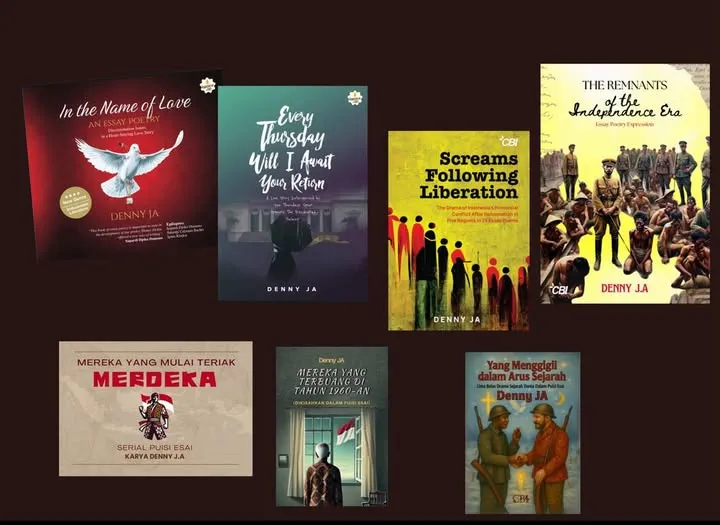
Now that Denny JA has been officially chosen as one of the ten global nominees for the 2025 BRICS Literature Award, we at Cerah Budaya International (CBI) present anew the historical journey he captures across seven monumental books of essay poetry.
Through these works, the histories of Indonesia and the world speak not with the speeches of victors, but with the conscience-whispers of those left in the ruins of time.
—000—
Histories Through Denny JA’s Lens
1) Atas Nama Cinta (2012) — translated as In the Name of Love (2012)
Book link: https://drive.google.com/file/d/1P-IdPe8IgOzSdNTWXcSTZ4OBgUrwBQDz/view?usp=sharing
This volume marks the birth of essay poetry—a new literary form that fuses social facts with lyrical language and keen empathy.
Through five love stories crushed by discrimination, Denny JA opens Indonesia’s social wounds: race, faith, gender, and orientation turned into borders that confine love.
He writes with a balance of research discipline and tenderness of heart; in every footnote lies history, and in every stanza, human tears.
The most shattering poem is “Fang Yin’s Handkerchief.” Fang Yin, a Chinese-Indonesian girl and survivor of the 1998 mass rapes, lives in Los Angeles for years with frozen trauma.
Each night she gazes at her lover’s handkerchief—once soaked in blood and tears. At life’s end, she burns it—not as a sign of vengeance, but as a ritual of self-redemption.
The scene becomes a spiritual metaphor: as the fire rises, the past burns away with its anger, and from the ashes a new woman is born—one who chooses forgiveness.
Denny JA writes not with fury but with healing compassion. He turns a history of violence into a story of inner resurrection. In Fang Yin’s small flame he sees a greater light: that a nation heals only when it dares to love again after its deepest wound.
—000—
2) Kutunggu di Setiap Kamis (2015) — translated as Every Thursday Will I Await Your Return
Book link: https://drive.google.com/file/d/1m_HZ9YDJXGVVgiBO7d_zr2H0YSXwOJy3/view?usp=sharing
A work that weaves a love story with human-rights activism.
Lina, a young woman who lost her husband—an activist abducted during the 1998 unrest—waits in front of the Presidential Palace every Thursday.
She becomes part of Aksi Kamisan, where mothers and wives of human-rights victims stand beneath black umbrellas, demanding justice that never arrives.
Denny JA writes in the cadence of elegy and prayer, offering love as resistance against oblivion.
At its height, Lina cries, “God, how many Thursdays dost Thou possess?”
The line shakes the soul; inside it dwell both weariness and a faith that refuses to fade.
Every Thursday she brings flowers and a photograph; the rain falls, her body shivers, but she waits still. For Lina, time is no longer linear—each Thursday a circle between hope and loss.
When at last she dies in old age, the young continue the vigil. Denny JA closes with a line that lingers: “Some prayers are too faithful to die.”
This poem touches the heart because it turns waiting into worship, and transforms loss into a moral force that will not be erased from the nation’s memory.
—000—
3) Jeritan Setelah Kebebasan (2018) — translated as Screams Following Liberation (2022)
Book link: https://drive.google.com/file/d/19VPQ8NrjCxVDEjAoCf1KEosIt7znDAEu/view?usp=sharing
A map of Indonesia’s wounds after reform. Denny JA portrays freedom tipping into chaos, when people injure one another in the name of tribe and God.
Across twenty-five essay poems, he records the tragedies of Maluku, Sampit, Lampung, Lombok, and Jakarta—not as reportage, but as existential meditation: democracy without conscience merely changes the mask of oppression.
The most searing piece is “My Daughter’s Tears at the Mall.”
Koh Enlai, a Chinese-Indonesian father who lost his child in the 1998 Klender Mall fire, is rendered with haunting, delicate detail.
Each year he lights a small dragon candle—symbol of love and remorse—speaking to the spirit of his daughter, Lian.
On the night of the twenty-fourth year, the candle becomes the final light guiding him to calm; he believes at last that his daughter now dances in heaven, a dragon circling the sky.
This is not merely a story of loss; it is about human steadfastness, seeking meaning amid ruins. Denny JA writes in the tone of prayer, not lament. He turns political tragedy into spiritual insight: parental love outlives time and creed, becoming a bridge toward history’s forgiveness.
—000—
4) Yang Tercecer di Era Kemerdekaan (2023) — translated as The Remnants of the Independence Era (2024)
Book link: https://drive.google.com/file/d/1Yacdm5TzSEyu0f1yfbXhlANe6eZsofJO/view?usp=sharing
This work returns readers to the dark years of colonialism and the Japanese occupation.
Denny JA writes from the perspective of those absent from textbooks: the jugun ianfu, the Romusha forced laborers, and the nyai—women trapped between love and subjugation.
He explores not only events, but the souls who bore them.
The most piercing poem is “Do Not Name Me Comfort Girl.”
Rahma, age fifteen, promised a singing job, is turned into a sex slave by Japanese soldiers.
In verse she whispers: “Do not call me comfort girl; call me Rahma—for I am still human.”
The line is an eternal moral cry.
Rahma seeks no revenge, only recognition—that her suffering is not shame but testimony.
The poem moves the heart because it teaches nobility within suffering.
When Rahma dies, her voice does not fade; it echoes for the countless women swallowed by silence.
With the empathy of a witness—without judging, without sensationalizing—Denny JA honors the courage of women who lost everything but dignity. Like Rahma, this poem refuses to be forgotten.
—000—
5) Mereka yang Terbuang di Tahun 1960-an (2024)
Book link: https://drive.google.com/file/d/1szruB2suenqBrUYq_lFmyIs9NzSWn6bO/view?usp=sharing
An elegy for Indonesia’s political exiles after 1965: students, artists, diplomats stripped of citizenship, unable to return.
They had been sent abroad under Sukarno to become future nation-builders. Politics changed. Sukarno fell. They were branded as his followers—even communists—turned into enemies of the state.
Denny JA portrays them not as ideologues, but as humans exiled between two homelands: one they love, and one that shelters them without warmth.
The most dramatic poem is “The Windmill Cannot Hold My Longing.”
Sarjono, a student from Malang living in Amsterdam, watches the windmill turn and believes the wind carries the scent of paddies from home.
At eighty-five, he realizes: his body belongs to a foreign land, but his soul still speaks Indonesian.
The most moving moment comes as he writes an unsent letter home: “I return each time I dream.”
This poem teaches that true exile is not measured by distance, but by losing one’s name in one’s own land.
With gentle melancholy, Denny JA turns longing into the purest form of patriotism—reminding us that history belongs not only to the victors, but also to those who gaze at home from across the window of the world.
—000—
6) Mereka yang Mulai Teriak Merdeka (2024)
Book link: https://drive.google.com/file/d/1i25w1Ot4tbbs5OHrh0a0jkowkpOjNF7y/view?usp=sharing
A sweeping panorama of Indonesia’s long struggle, rendered through fifteen essay poems that reawaken the pioneers of the national movement—from Dr. Soetomo and Haji Samanhudi to Tan Malaka, Sjahrir, Sukarno, and Hatta.
In Denny JA’s hands, history is not a list of dates and grand names. It becomes inner drama—where heroes are not statues, but humans who doubt, tire, fall in love, and keep walking alone through the era’s darkness.
Each poem mirrors the fires that kindled Indonesia: the fires of education, commerce, diplomacy, and moral courage.
From “And Thus Budi Utomo Was Born” to “Mohammad Hatta and the Frenzy of Corruption,” this book braids chronology into a single emotional narrative about the price of independence and the anxieties that followed it.
The most stirring poem is “And Two Thousand Widows Charged Forth.”
With mythic vigor and history’s tears, Denny JA raises the story of Admiral Malahayati—the world’s first female naval commander—leading two thousand Acehnese widows whose husbands were lost to war.
On the night before battle, she whispers: “My sorrow is the ember that will burn the invaders.”
When Malahayati strikes down Cornelis de Houtman, the sea bears witness: bravery does not always come from men at arms, but from women who fight because they cannot endure waiting.
She fights not for ambition, but for love and the dignity of her people.
This poem rekindles the meaning of merdeka—not as a diplomatic settlement, but as a widow’s cry that has lost everything but courage.
As a whole, Mereka yang Mulai Teriak Merdeka is an emotional encyclopedia of the nation—great history told through intimate stories that awaken conscience.
Denny JA closes with words that read like a prayer:
“Essay poetry revives history—giving breath to its figures, letting them feel pain, and whisper to the reader.”
A monumental work—not only for Indonesian literature, but for the soul of a nation seeking to remember where the first spark of freedom was lit.
—000—
7) Yang Menggigil dalam Arus Sejarah (2025) — Denny JA
Book link: https://drive.google.com/file/d/12ecyTSvXNfvN48XD4IGyQlwZo12f7VfC/view?usp=sharing
If the previous six books record Indonesian history, this one reaches the world: from the French and Russian Revolutions to the World Wars, the Holocaust, Mao Zedong’s revolution, and the tragedy of Vietnam.
Fifteen essay poems capture great historical episodes that shake human conscience: the Christmas truce that stopped the guns of World War I, the massacre at Nanking, the fall of the Tsar, the Vietnamese boat people.
Each story spotlights small human beings swept in the torrent of their age: victims, survivors, witnesses trembling in the current of history.
In his preface, Denny JA writes that numbers in history often freeze, but literature gives them breath. He rejects cold, objective history and chooses a history that “beats within the human chest.” Essay poetry becomes a bridge between fact and empathy, between archive and prayer.
Most Touching Poem: “Christmas Night in the First World War.”
Set in 1914, in Ypres’s muddy trenches. A young German soldier, Ernst Keller, hears Silent Night drifting across Christmas Eve.
From the opposite trench, the British and French answer with the same melody.
He climbs out unarmed, heart pounding; the enemy does the same.
Amid snow and scattered bodies, they shake hands, share cigarettes and chocolate, even play football. For one night, war stops; humanity lights its candle in the dark.
At dawn they are ordered to fire again. But Ernst knows something has died within him—not his body, but the part that obeys hatred.
Denny JA writes with soft reflection:
“We were not enemies, only children lost inside history.”
The poem affirms the book’s central message: behind every victory and every tragedy, there is someone praying alone that the meaning of “human” will not be extinguished.
—000—
Epilogue
Across these seven books, Denny JA writes history not with a historian’s pen, but with a poet’s blood.
He records the wounds of nation and world with a tenderness that feels like prayer, making each stanza a monument to forgotten souls.
From In the Name of Love to Trembling in the Currents of History, we trace the arc of a pioneer: from love oppressed, to a nation struggling, to a civilization bleeding.
In the end, one message remains: humanity is the most universal language of history.
Essay poetry turns history from mere remembrance of the past into a mirror for the future.
It shows that a nation endures only when it dares to remember with the heart, not with anger.
In Denny JA’s hands, history breathes again—not as a list of years and wars, but as the story of human beings who still tremble as they search for light. ***
Jakarta, October 30, 2025
References
1. T. S. Eliot — “Tradition and the Individual Talent” (1919).
(A classic essay affirming that great literature is born from dialogue with history.)
2. Hayden White — Metahistory: The Historical Imagination in Nineteenth-Century Europe (1973).
(A landmark work showing that history is not mere fact, but narrative shaped by moral and aesthetic imagination.)
—000—
Hundreds of Denny JA’s essays on philosophy of life, political economy, literature, religion and spirituality, democratic politics, history, positive psychology, travel notes, and reviews of books, films, and songs can be found here:
Facebook — Denny JA’s World: https://www.facebook.com/share/p/1BZ8yFNBhP/?mibextid=wwXIfr
Rubrik Khusus
HISTORY CAPTURED THROUGH DENNY JA’S SEVEN BOOKS OF ESSAY POETRY
22 Nov 2025
-
Sumber Foto: DennyJAWorld